


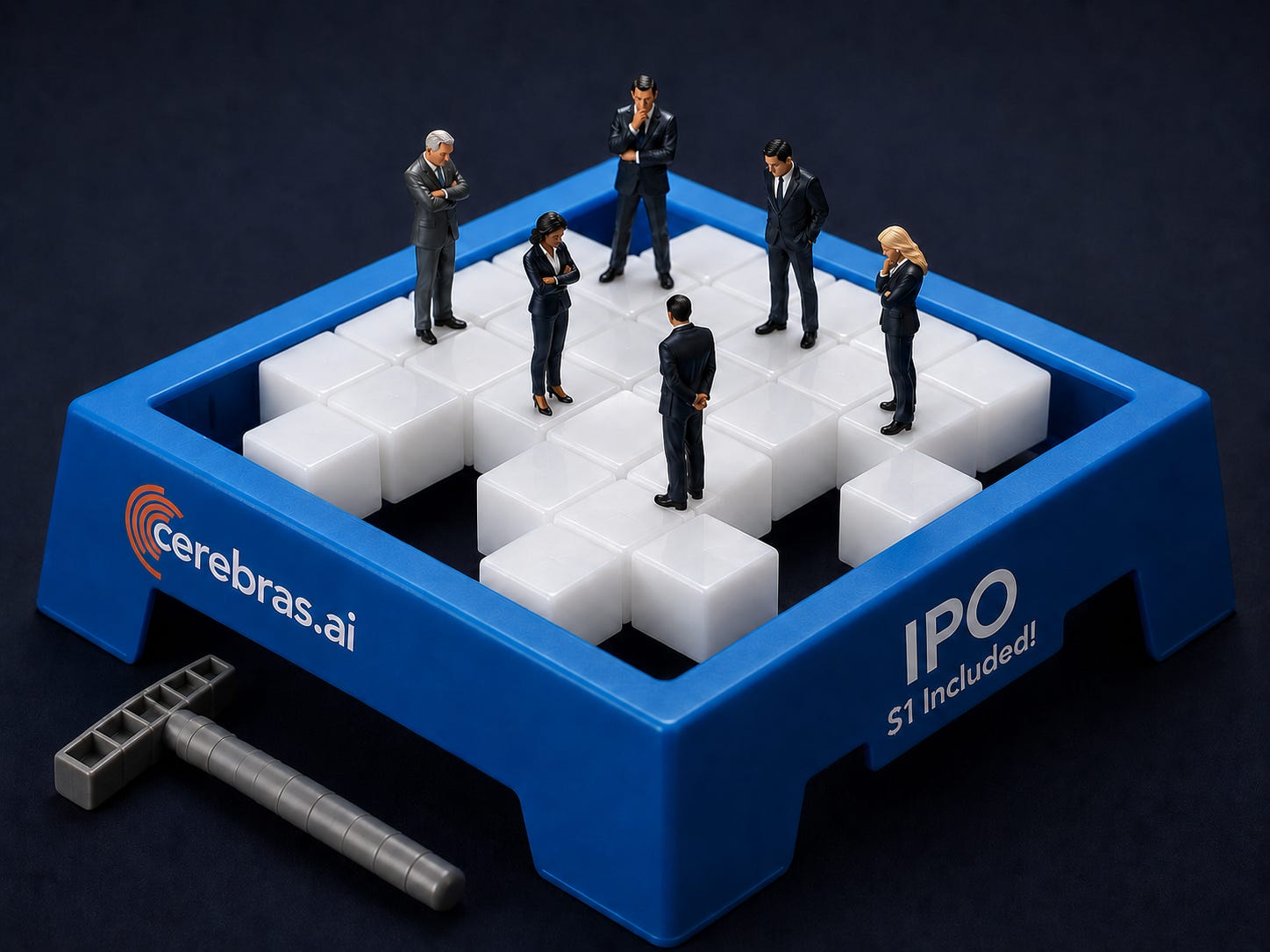
TL;DR -- The IPO essentially prices in fully successful execution. The lock-up calendar and the natural earnings cycle commit Cerebras to a read-out on execution within just two earnings cycles. The bet is narrow and time-bounded.
Cerebras Systems filed its Form S-1/A on May 4, 2026, and is expected to price its IPO around May 13 at $115-125 per share. At the top of the range, the offering implies an equity value of $26.6B on 213M post-IPO shares, raising $3.5B in gross proceeds before the underwriters’ over-allotment option.
The headline numbers in the prospectus are striking. Revenue grew from $24.6M (2022) to $510M (2025), more than 20x increase in three years. Q4 2025 alone produced $171M of revenue, up 110% YoY. First full year of GAAP net income at $237.8M. The S-1 also announces a multi-year deal with OpenAI valued at more than $20B and a term sheet with Amazon to deploy Cerebras systems in AWS data centers.
But read the disclosure more carefully and a more complicated picture emerges:
A reported “first profitable year” driven entirely by a non-recurring non-cash gain.
High customer concentration: 86% of 2025 revenue from two UAE-government-linked related parties.
A wafer-scale moat that depends on TSMC capacity Cerebras has no contractual right to.
Material weaknesses in the GAAP areas central to the offering, plus an auditor change three months before pricing.
A 50x P/S multiple, more than four times the closest comparable IPO.
A staircase lock-up that releases roughly 80% of the float in six months.
The goal of this report is not to recommend or oppose the offering, only to surface what the S-1 actually says and what an informed investor should weigh before participating (see our General Disclaimer).
Behind the headline numbers
What jumps out when looking at the S-1 financials: the reported GAAP net income of $237.8M is almost entirely a $363M non-cash gain on extinguishment of a forward contract liability tied to the Series F preferred stock purchase agreement. Non-GAAP net income is a $75.7M loss, wider than the $21.8M loss in 2024. Operating cash flow swung from $452M in 2024 (driven by $640M of customer-deposit increases from G42 and MBZUAI prepayments) to a $10M outflow in 2025 as those prepayments were earned out. The GAAP operating loss widened from $101M to $146M and the non-GAAP operating loss more than doubled from $43M to $96M. Revenue grew rapidly in 2025 due to a one-time event; the underlying operational economics did not.
Significant customer concentration
For the year ended December 31, 2025, Cerebras derived 24.0% of revenue from G42 Holding Ltd, an Abu Dhabi-based technology group, and 62.0% from Mohamed bin Zayed University of Artificial Intelligence (MBZUAI). The combined 86% of revenue from two customers, both of which the company designates as related parties under ASC 850, warrants close attention.
This concentration is an outlier among public peers. NVIDIA’s largest direct customer accounted for 21% of fiscal 2026 revenue. Broadcom’s largest customer in its semiconductor solutions segment was 32%. AMD’s last separately disclosed top customer was 18% in 2023. Intel’s largest customer was 19% in 2025, with the top three combining for 43%. Super Micro Computer’s two named customers combined for 32% (20.9% Customer A plus 11.1% Customer D). Cerebras’s top-two concentration of 86% is roughly 2.5x to 4x the concentration of any peer in the operational comp set.
Two further issues complicate these relationships. First, both UAE customers operate under US BIS export licenses for Cerebras’s CS-2, CS-3, and CS-4 systems, and the prospectus notes that BIS plans to issue new rules. Tightening or revocation would directly affect Cerebras’s largest revenue streams. Second, Cerebras issued G42 warrants for 3.5M Class N shares at $0.01 per share, fully exercised; at the $120 IPO midpoint, those shares are worth approximately $422M against $35,000 of total cash consideration. That warrant value amortizes as non-cash contra-revenue against future G42 revenue beginning Q1 2026, meaning reported related-party concentration in 2026 will appear lower than the underlying cash-economic concentration even if G42 purchases hold steady. None of this resembles a standard customer relationship.
The OpenAI relationship, signed in December 2025, has been positioned as the catalyst that diversifies Cerebras away from UAE concentration. The Master Reseller Agreement (MRA) commits OpenAI to deploy 750 megawatts of Cerebras compute capacity in tranches from 2026 through 2028, with an option for additional capacity through the end of 2030, valued in aggregate at more than $20B. This structure includes terms that also go beyond a standard customer relationship.
OpenAI advanced Cerebras a $1.0B Working Capital Loan with account-control rights on material breach, effectively a soft lien on operating cash. OpenAI also received a warrant for ~33.4M Class N shares at $0.00001 per share, vesting as compute capacity is delivered up to 2 gigawatts and worth up to ~$4B at the $120 IPO midpoint. That value amortizes as non-cash contra-revenue against future OpenAI revenue, mirroring the G42 dynamic at roughly 10x the scale. The MRA also bars Cerebras from selling to certain unnamed OpenAI competitors, narrowing the addressable market in a way the headline TAM figures don’t reflect.
The AWS relationship, announced in March 2026, is described as a binding term sheet. The definitive agreement is “subject to negotiation and execution” and the disclosure notes that the parties may not reach final terms. AWS received a warrant for 2.7M Class N shares at $100 per share, vesting tied to product purchase volumes substantially beyond the initial lease.
Customer concentration will factor heavily into the read-out for the next two earnings cycles. Q1 2026 will show the first revenue mix data after the OpenAI MRA was installed. Q2 2026 will be the first full quarter of OpenAI capacity deliveries and will reveal whether AWS converted into a definitive agreement. If G42 and MBZUAI remain at 75-85% of revenue through Q2 2026, the diversification thesis embedded in the IPO valuation has not yet materialized at the moment that the largest single lock-up release (~36M shares) is hitting the float. That alignment puts concentrated insider supply onto the market exactly when the bull-case narrative is most exposed, the kind of setup that typically produces sharp price declines for new IPO investors.
The wafer-scale moat depends on TSMC
Cerebras’s central technical claim is that it has commercialized wafer-scale integration: an AI processor built across an entire silicon wafer, with 4 trillion transistors and 46,225 square millimeters of silicon, marketed as 58 times larger than an NVIDIA B200 chip. This is a genuine technical achievement. It is also achievement that depends on a foundry partner.
The S-1 is direct on this point. Cerebras is fabless and depends on TSMC to manufacture all of its wafers. The processes that make wafer-scale possible -- multi-die interconnect at the wafer level, fault-tolerant architecture that routes around defects -- were co-developed with TSMC and depend on TSMC fabrication equipment and techniques. Cerebras has no formalized long-term supply or allocation commitments from TSMC, and TSMC also fabricates wafers for Cerebras’s competitors, heavyweights including NVIDIA and AMD, who are significantly larger TSMC customers. The disclosure notes that TSMC could reduce or eliminate deliveries to Cerebras on short notice or raise prices, with material consequences.
Cerebras runs roughly two years behind NVIDIA on node. WSE-1 (TSMC 16nm) shipped in 2019, WSE-2 (7nm) in 2021, WSE-3 (5nm) in 2024. NVIDIA’s H100 reached TSMC 4N, a customized 4nm-class node, in late 2022, roughly two years before Cerebras reached 5nm. By 2024, NVIDIA Blackwell was already shipping on TSMC 4NP, an enhanced 4nm node, putting NVIDIA roughly a full generation ahead even on parallel-year timing. NVIDIA’s next platform (Rubin, expected on TSMC 3nm in 2026) will widen the gap. The S-1 contains no commitment around WSE-4 node selection, foundry capacity, or timing relative to that roadmap.
Internal controls and the auditor change
The S-1 discloses material weaknesses in internal control over financial reporting for FY2024 and FY2025 that remain uncured at filing, including “inadequate or missing resources” to apply GAAP across four areas: revenue recognition, inventory management and costing, data center assets accounting, and equity administration. These are exactly the line items most material to the IPO narrative, covering the $510M top-line, the asset base supporting $668M of 2025 capex, and the warrant accounting, forward contract liability, and founder PRSU stock-based compensation that together produce the headline GAAP net income.
On November 10, 2025 Cerebras dismissed BDO USA, P.C. as its independent auditor and engaged KPMG LLP to audit the consolidated financial statements for the year ended December 31, 2025. Audit firm upgrades during IPO processes certainly have precedence, but they typically occur well before the S-1 process begins, not three months before pricing. KPMG’s first audit of the company is the same audit that supports the offering, with material weaknesses still in remediation. Cerebras is exempt from the Sarbanes-Oxley Section 404(b) auditor attestation requirement on internal controls for up to five years, so the auditor is unlikely to issue a public opinion on the company’s internal controls until well past the IPO. For new IPO investors, this concentrates accounting risk in the same two earnings cycles when the rest of the IPO thesis is being tested.
Operational comp set
The closest public peers, screened for businesses doing comparable work for comparable buyers, fall into three tiers: (1) direct AI-accelerator competitors (NVIDIA, AMD), (2) custom AI silicon for hyperscalers, with hyperscaler-concentration analog (Broadcom), and (3) AI server systems integration (Super Micro). Intel is included separately as a cautionary case: an incumbent that has tried for years to take AI-accelerator share from NVIDIA with poor results.
Cerebras’s gross margin sits between the chip designers (NVDA at 71%, AVGO at 68%, AMD at 50%) and the systems integrator (SMCI at 11%). Intel, the most operationally analogous comp on margin profile, runs at 34.8%, slightly below Cerebras.
Intel is a relevant cautionary tale. Despite a $50B-plus revenue base, established hyperscaler relationships, and a continuous silicon roadmap, Gaudi 3 missed Intel’s $500M revenue target, the Gaudi line was wound down, and Intel canceled its planned successor Falcon Shores in January 2025. Intel’s overall revenue was essentially flat from $53.1B in FY24 to $52.9B in FY25 at 34.8% gross margin. The Q1 2026 stock pop reflected CPU strength, foundry deals (Google), and AI inference partnerships (SambaNova), not a successful AI-accelerator product of Intel’s own. Intel’s strategic conclusion was to stop competing head-on with NVIDIA in accelerators and instead position CPUs as complements and pursue custom-silicon work. The bull case for Cerebras has to explain why Cerebras, with vastly less scale and a single dominant customer relationship, succeeds in growing AI-accelerator share where Intel essentially gave up.
Valuation multiples
At the $120 IPO midpoint, Cerebras’s implied value is approximately $25.6B on 213M post-IPO shares; at the top of the range it reaches $26.6B. Against $510M of trailing revenue, that prices the company at roughly 50x to 52x trailing P/S.
Peer figures from Yahoo Finance key-statistics pages, current as of early May 2026 and subject to update as Yahoo’s live data refreshes. Cerebras values are computed from the S-1/A: implied equity value = 212,965,381 post-IPO shares × IPO price; P/S = implied equity value / $510M FY25 revenue.
CoreWeave’s ~11x trailing P/S is the most relevant valuation reference, though the businesses differ structurally: CoreWeave is a specialist AI cloud (GPU-as-a-service) that buys NVIDIA chips, not a silicon designer that competes with them. Even with that caveat, CoreWeave’s growth (~140% guided for 2026), gross margin (71.7%), and $5.1B FY2025 revenue base are stronger than Cerebras’s, yet the public market is paying just ~11x P/S. Cerebras is offering at roughly 4.7x that multiple.
NVIDIA at roughly 23 times P/S is the most-richly valued mega-cap chip name and Broadcom trades at roughly 28 times P/S on the strength of its AI custom-silicon segment growth. Cerebras is being priced at roughly 2.2x NVIDIA’s multiple and 1.8x Broadcom’s, while delivering a fraction of either company’s profitability or ecosystem depth. The bull case requires Cerebras to grow into NVIDIA-like or Broadcom-like margins at much larger scale, which means hitting essentially the full OpenAI ramp, plus AWS conversion, plus customer base diversification, in roughly two to three years.
What this means for an IPO investor is that the entry multiple already prices in fully successful execution. There is no valuation cushion to absorb a missed customer-concentration improvement, an AWS deal that does not close on favorable terms, or a slip in the OpenAI capacity ramp. Each of those outcomes will be visible within the next two earnings cycles.
Lock-up structure: A staircase, not a cliff
Cerebras has structured a staircase lock-up release tied to earnings dates and a price-trigger:
Day 1: 7.5% of “Eligible Securities” held by non-executive employees (~2.6M shares) releases automatically.
Day 2: another 7.5% releases if the stock closes above 133% of the IPO price on Day 1 ($159.60 at midpoint, $166.25 at top).
After Q1 2026 earnings: 27-30M shares release, depending on whether the Day 2 price-trigger was satisfied.
After Q2 2026 earnings: 36.4M shares release.
Aug-Oct 2026: six biweekly tranches of 14-19M shares each.
After Q3 2026 earnings or 180 days post-IPO, whichever first: the remainder.
Approximately 171M of the 213M post-IPO shares (roughly 80% of the float) release over the six months following the IPO.
Two features of the calendar shift risk toward the IPO buyer. First, the Day 2 price-trigger soft-caps any rally on the first day of trading: a close above $159.60 brings 2.6M additional shares (~$416M at $160) into the market the next morning, pulling forward supply that would otherwise wait until after Q1 earnings. Second, the largest single supply event (36.4M shares) is calendared two days after Q2 2026 earnings, when the founder PRSU stock-based compensation charge of $370.9M hits the income statement and the customer-concentration disclosure runs its first full-quarter test following the OpenAI MRA. Other recent staggered IPO lockups (CoreWeave, Astera Labs, Klaviyo, Rubrik) tie their largest releases to price triggers fired by stock appreciation or to fixed dates without company-specific catalysts; Cerebras uniquely concentrates a major supply event on a day when both reported earnings and the central bear-case disclosure are most likely to disappoint. The calendar is asymmetric for new IPO investors: upside is capped, downside concentrated by structural design.
Diligence questions
Three diligence questions worth asking the underwriters before pricing.
What is the contractual revenue commitment from G42 and MBZUAI for 2026 and beyond, and what are the cancellation terms? The 86% related-party concentration is the central operational risk, and the S-1 discloses what G42 and MBZUAI paid historically without disclosing whether they are contractually obligated to keep paying.
What is the quantified contra-revenue impact from customer warrants expected in 2026? The G42 and OpenAI warrants (~$4.4B of equity value at the IPO midpoint) start amortizing against reported revenue in Q1 2026, and without management’s quantification, 2026 reported revenue and concentration percentages will not be directly comparable to 2025.
Has Cerebras committed foundry capacity for WSE-4 at a node that will be competitive with NVIDIA’s Rubin Ultra in 2027, and what is the capital expenditure commitment? WSE-3 ships on TSMC 5nm, one node behind Blackwell and two years behind H100, and without a committed WSE-4 capacity reservation at a competitive node, the wafer-scale advantage has a 12-24 month half-life as Rubin ramps on 3nm.
A narrow path
The path to a successful IPO investment is narrow and the timeline is short. The valuation prices in successful execution across several dimensions in parallel: customer-concentration improvement, AWS conversion to a definitive agreement, OpenAI capacity ramp on schedule, and a credible foundry roadmap for the next-generation product. The disclosure structure pre-commits Cerebras to surfacing progress on each within two earnings cycles. So, by the end of October 2026, roughly 63% of the float will have released and the bull case will either have materialized visibly or slipped visibly. New investors are taking a defined, time-bounded bet. Whether to take it depends on conviction that several specific outcomes resolve favorably within six months, not on a multi-year horizon.
Compensation Disclosure: No part of the compensation of any Revelata personnel was, is, or will be directly or indirectly related to the specific views, conclusions, or recommendations expressed in this report, or to the coverage of any particular security or issuer herein.
General Disclosure: The information contained in this report is provided for informational purposes only and is not intended to constitute financial advice or a recommendation to buy, sell, or hold any securities. The opinions expressed herein are as of the date of publication and are subject to change without notice. This report does not take into account the investment objectives, financial situation, or specific needs of any individual investor.
We are not a licensed financial advisor, broker, or dealer, and this report is not intended to provide investment, legal, accounting, or tax advice. Any reliance on the information contained in this report is at the sole discretion and risk of the user.

