


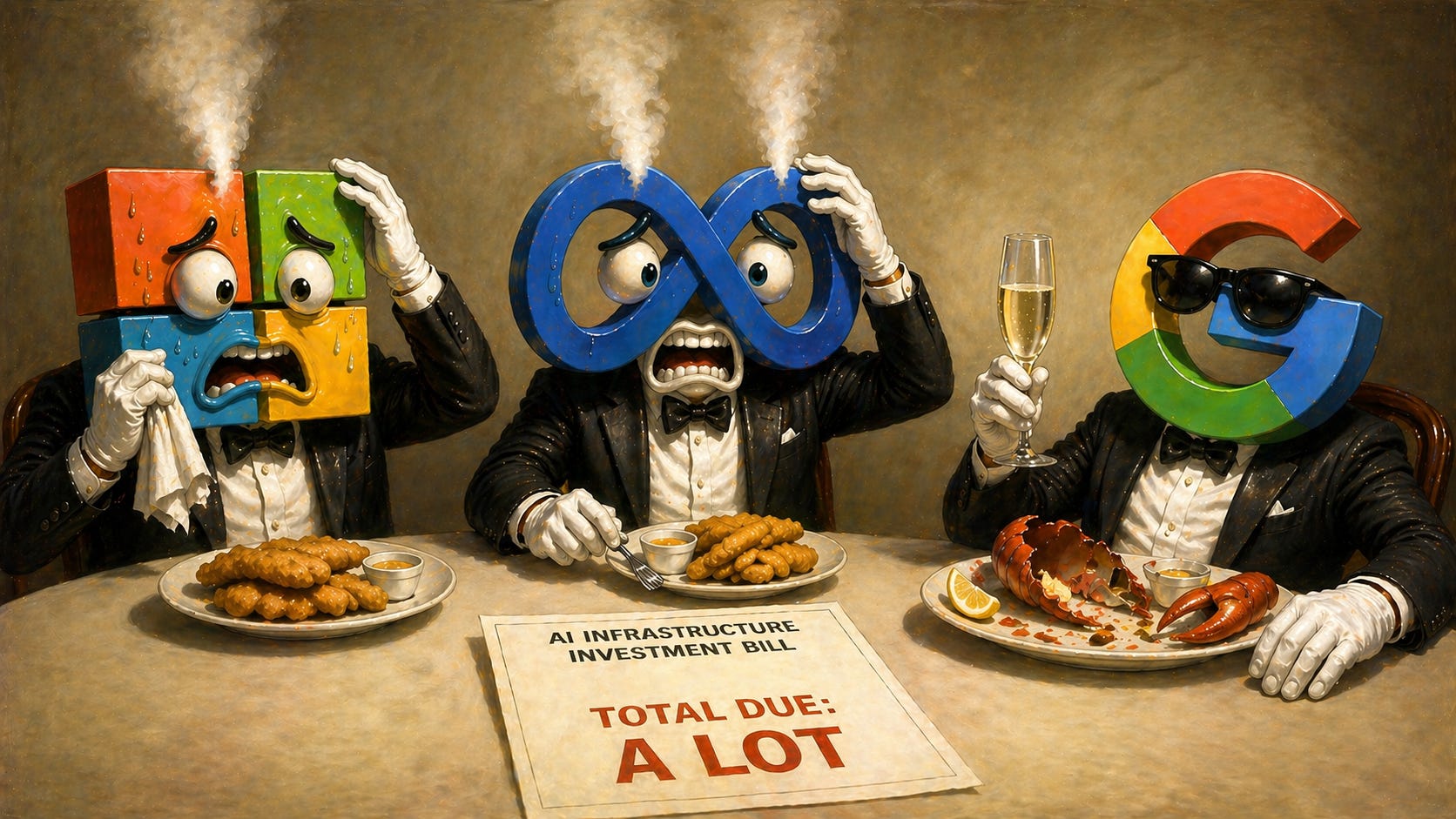
Microsoft , Meta, and Alphabet Inc.‘s earnings calls yesterday were high drama, and their stock movement day-after shows it:
🟢 GOOGL: +10% 🔴 MSFT: -4% 🔴 META: -8%
The background is that all three are in the early stages of an absolutely massive multi year AI infrastructure bet; they’re nowhere near peak spend today, and investors are looking for clues about what things will look like a few years down the line. Our series this week on MSFT, META, and GOOGL showed that MSFT and META are running the engine much hotter than GOOGL. They’re aggressively pulling various levers (e.g. headcount, depreciation, debt) to fund their AI investment. Meanwhile, GOOGL’s investment is the largest and, compared to peers, they could afford to invest even more. Strategically, if there’s a gap among them, GOOGL has an opportunity to widen it.
The biggest questions going forward are whether (1) the core businesses that fuel these AI build-outs keep humming, and (2) whether costs stay in control over the long haul (said another way, will the core businesses hum fast enough for long enough?). Even if the math works today, with leases-not-yet-commenced of $196B at MSFT, $183B at META, $76B at GOOGL not on the P&L yet, the math needs to hold through 2028 at least.
Something like memory prices -- which Zuckerberg opened with -- mean something different at each company. For META and MSFT, supply constraints create worries of longer build timelines and higher costs. That means more risk of the profit engine hitting max capacity and the backup levers not providing enough juice to keep going towards AI dominance. At GOOGL, supply constraints paint a more optimistic picture. They explain why the investment isn’t even larger today and also why there’s an absolutely massive backlog for their cloud services. Should supply ease, GOOGL’s investment could skyrocket overnight and the profit engine would accelerate alongside it. All three live in the same world but are affected differently by it.
To get into the numbers:
GOOGL’s self-funded bet looked stable as ever. OCF grew $10B. Capex grew $19B. FCF dropped, but cash + securities ended at $127B, flat with year-end. Cloud op inc tripled to $6.6B while segment margin went 18% → 33%. Backlog nearly doubled in one quarter to $462B. And the biggest risk, that search might stall, not only didn’t materialize, but looked less likely: search reaccelerated with revenue +19% and paid clicks +13% after five years of deceleration, alongside evidence that “AI Mode” is growing their search business rather than hurting it.
MSFT showed evidence that its profit engine is holding together, but the consequences of its spending are already being felt. The good news was that the core (Azure +40%, M365 +19%) is fine. But the FY26 capex guidance was ~$190B, when consensus had been ~$155B, and there’s still another quarter left in the fiscal year. Depreciation +55% YoY. Q4’s op margin guidance was ~44%, down from Q3’s 46.3%. Intelligent Cloud’s cost of revenue was +47%, on revenue +30%. What we saw was that the cost of running the AI bet is now showing up inside the segments that fund it, and it’s still very early. This was a cause for concern.
META got hit hardest. The bull thesis was: “this engine is so profitable it can absorb the buildout.” Their ad engine accelerated with impressions +19%, price per ad +12%, total revenue +33%. This was the fastest growth quarter since 2021. But the Family of Apps segment margin still went from 52% → 48%. Costs grew +44% on revenue growth of +33%. The AI bet is now embedded inside FoA through AI talent comp and infrastructure depreciation, and it is dragging margin even as the engine screams.
Then three more things landed: Capex guide raised again ($115-135B → $125-145B), the second raise this year. Contractual commitments roughly doubled in a quarter to $238B, plus $24B added in April. The off-balance-sheet picture is bigger than reported. Hyperion was fully disclosed for the first time with $46B max exposure, lease commitments starting 2029. And this came with 8,000 layoffs announced pre-print, confirmed by Susan Li on the call “to offset the substantial investments we’re making.” The takeaway was that META is firing 10% of staff to fund the buildout, FoA margin is compressing, and they had to raise capex because supply costs mean they’re not fully in control.
To synthesize all this:
The three companies have the same capex on three different P&Ls.
The market priced them by which engines can carry the buildout to 2028.
The gap between GOOGL and the other two just got wider. They have the strongest core business, the cleanest funding math, an excellent frontier model, and the ability to hit the gas even harder.
The other two are pulling levers to supplement the cash generated by their core businesses. The consequences underscore that management does not have as much control or room for error as anyone would like.
All numbers above were sourced via Revelata’s deepKPI, which gives you one-click auditing on every datapoint and integration into Excel, Claude, ChatGPT, OpenClaw, or your agent via API. The framework worked. Three theses backed by hard data that told you exactly how these companies work. You should try it yourself.
