


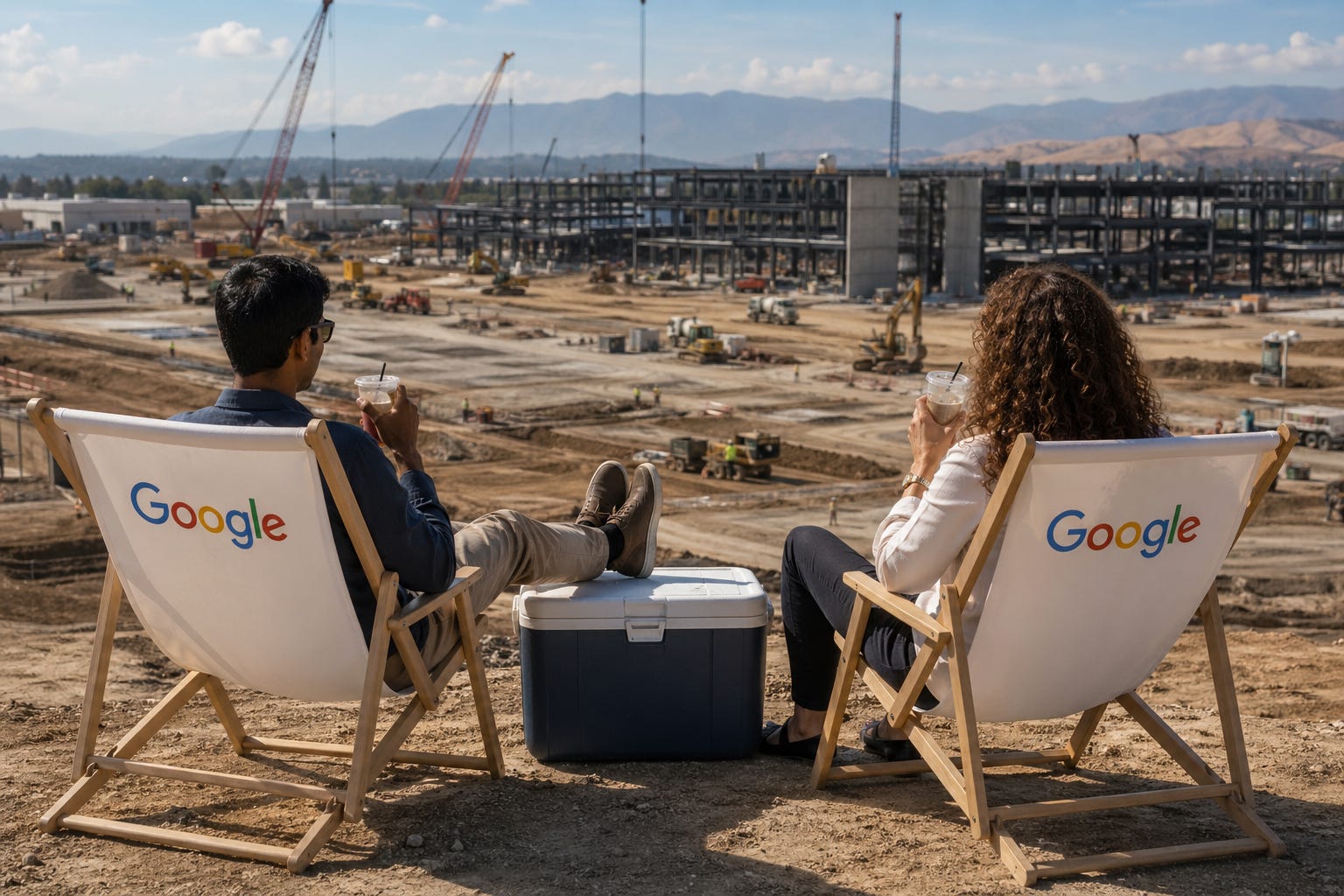
Alphabet reports Q1 2026 today. The AI outlay is similar to Microsoft and Meta but the risk profile is very different. Differentiation comes because Alphabet generates enough new operating cash to cover the entire capex doubling: in FY25, operating cash flow grew by $39B and capex grew by $39B. Free cash flow held flat. This is a stark contrast to MSFT and META, who are burning cash, raising debt, and laying off staff, stretching contract durations, and changing equipment depreciation timing to fund their outlay.
The catch to listen for is whether this self-funding math is a FY25 result, not a forward promise. With FY26 capex guided to $175-185B, FCF is set to drop ~70% even with continued OCF growth. Today answers whether the engine is good enough to keep self-funding the bet or whether GOOGL starts looking more like its peers from here.
The questions for Wednesday: is Cloud’s profit acceleration sustainable, are AI Overviews biting Search enough to change the equation, and where in the $175-185B FY26 capex range does the guide actually land? Alphabet has room to absorb some wobbles, and absent that, should arguably be spending even more on AI to gain a competitive advantage.
A rundown of their recent data:
Search: AI Overviews are biting clicks, but pricing absorbs it. Paid clicks have decelerated five straight years (23% → 10% → 7% → 5% → 6%) — when AI summarizes the answer, fewer people click through. But CPC went +1% → +7%→ +7%. Search & other grew +13.4% to $224.5B for FY25, and the exit rate was stronger: +17% in 4Q25, ahead of expectations. AI Mode is the mechanism with longer conversational queries sustaining higher CPCs without degrading the experience. Listen for: paid clicks holding at +6%, CPC growth holding at +7%, AI Mode adoption beyond early users. Worth knowing on the side: Google Network ads are in structural decline ($31.7B → $29.8B over four years) on EU pressure and mix shift to owned-and-operated. YouTube ads have been quietly excellent (+11.7%), roughly at parity with Netflix’s entire revenue (e.g. FY25 at $40.4B).
Cloud is the AI ROI proof point. Operating income went $1.7B → $6.1B → $13.9B over three years. Revenue $43B → $58.7B (+36% in FY25), with 4Q25 accelerating to +48%. Segment margin moved from 14% to 24% in one year, 960 basis points of expansion. RPO (backlog) jumped from $93.2B to $242.8B, with 50% recognizable beyond 24 months, and that backlog is now roughly in line with AWS’s $244B despite GCP being half the revenue size. This is the same long-duration contract play MSFT runs, but with 36% revenue growth underneath it and a backlog that just caught the category leader. Listen for: Cloud opinc growth. The buy-side bar is +60-65% y/y; anything below that disappoints, anything above sustains the inflection thesis.
The bet: capex investment is bigger than Meta, and went from $52.5B → $91.4B. The off-balance-sheet picture is comparable in scale: property not yet in service $50.6B → $78.6B, leases not yet commenced $6.5B → $58.5B, total purchase commitments $55.4B → $149.1B. Plus Wiz at $32B (likely closing this quarter) and Intersect at $4.8B pending close.
Alphabet is funding it three ways, and the mix is what makes them different from peers:
Cash from operations, the dominant lever. OCF grew $39B in FY25, exactly matching the capex increase. They didn’t need the other levers in any survival sense for FY25.
Debt, opportunistically. Long-term debt quadrupled $10.9B → $46.5B. Big issuances were $5B in May (24-yr WAM), $17B in November (4.92%, 20-yr WAM), €6.5B in euros, all issued while still cash positive to lock in long-duration funding, not plug a hole. Cash + securities actually grew from $95.7B to $126.8B.
Accounting, the lever already pulled. Server useful life: 5 yrs → 3 yrs (2020) → 4 yrs → 6 yrs (2023+). They moved earliest and went furthest. Less juice left here than at META.
In terms of risks, keep an eye on the centralized Gemini training costs. Operating loss went -$10.5B → -$16.8B in one year. That’s the Gemini training/talent bill, comparable in scale to META’s $19B Reality Labs loss. Other Bets loss also accelerated -$4.4B → -$7.5B, and Waymo just took a $16B funding round in February to fund expansion. These are all much less concerning than META’s RL because Gemini and Waymo are actually generating commercial revenue.
One footnote that will trip up Q1 coverage: a $32B event in January 2026 — additional unrealized gains on non-marketable equities, almost certainly the Anthropic stake being marked up. This hits Q1 net income as a non-cash, non-operating gain. Anyone reading “Alphabet beats EPS by $X” without backing this out will be confused. Focus on the operating numbers.
In the end, Alphabet grew operating income 15% to $129B while doubling capex, quadrupling debt, absorbing a $3.5B EU fine, and growing the centralized AI training bill by $6B — and held operating margin flat at 32%. They did it without the layoffs, off-balance-sheet structures, or cash crunch that defined META’s year. The framing is whether Alphabet’s stability shows signals of looking more like its peers, and if not, whether they should be spending even more aggressively to widen the lead.
All numbers are from Revelata’s deepKPI, which gets you 1-click auditing on every data point and hooks into Excel, Claude, ChatGPT, OpenClaw, and your API. Your ability to get under the surface of any company has never been more potent: data and analysis tools like never before.
