


American Eagle (AEO) runs two main apparel brands: the namesake American Eagle chain and the body-positive intimates and activewear brand Aerie. American Eagle sells jeans, t-shirts, and casual wear out of mall stores, while Aerie sells intimates, sleepwear, and activewear (under an OFFLINE sub-line).
The story has always been about denim and the back-to-school floor, with Aerie as the side project. In Fiscal 2025 that changed when Aerie grew $1.94 billion in revenue, up 12% year-over-year, while the American Eagle brand mostly stood still at $3.41 billion, up less than 1%. The surprising result is that the Aerie segment’s $345.9 million operating income is now within striking distance of American Eagle’s, despite Aerie being just over half the revenue size.
Strategically, AEO faces a few real problems. First, Abercrombie & Fitch is winning.
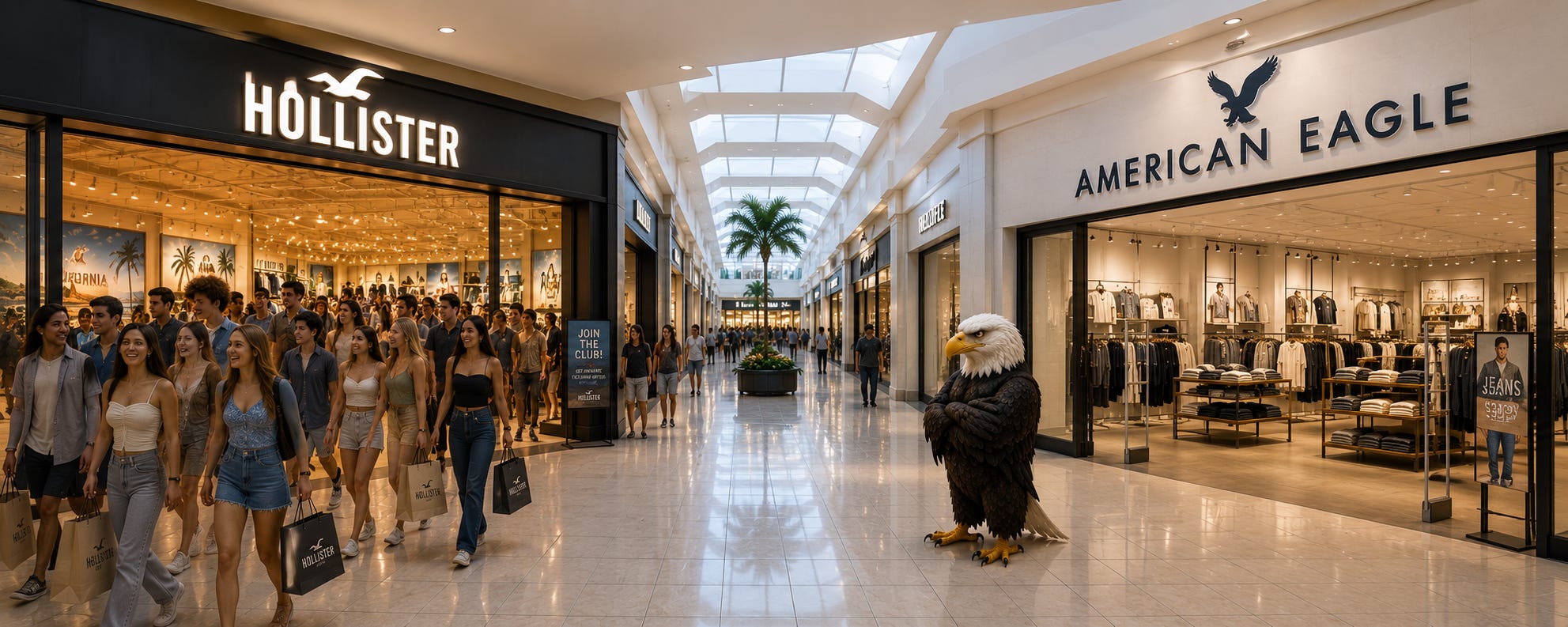
ANF‘s FY25 operating margin was 13.3% against AEO’s GAAP 4.1% on similar revenue, and Hollister grew net sales 15% in FY25 against Aerie’s 12%. American Eagle was the dominant teen mall denim brand for most of the 2000s and 2010s but Hollister has taken that position, and the AE brand has stopped growing, which puts all the consolidated growth pressure on Aerie. Second, the tariff regime keeps moving: IEEPA was struck down in February, the Section 122 replacement expires in late July, and there’s no clear successor. Third, after a heavy capital return year, cash plus short-term investments are down from $454 million two years ago to $239 million.
Management’s strategy in Fiscal 2025 was to lean into Aerie. The company opened 14 net new Aerie stand-alone locations to 332 while closing 24 American Eagle stores to 805, with more Aerie and OFFLINE openings planned for Fiscal 2026. Meanwhile, the company absorbed $130 million of gross tariff pressure, with $50 million in Q4 alone, dragging full-year gross margin down 270 basis points to 36.5%. In a show of confidence, AEO bought back stock at its trough, spending $201.8 million on an Accelerated Share Repurchase that delivered 18.4 million shares at an average price of $10.86.
With this backdrop, here’s what we’re watching:
Aerie’s Exit Rate. Aerie comp went from negative in Q1 FY25 to +23% in Q4 FY25, with full-year comp of +9%. Listen for Aerie comp at +10% or better, and interpret anything below mid-single-digit as a suggestion that the engine has lost compounding.
American Eagle Returning. AE brand comp was flat for FY25 with a +2% Q4 print, the first positive comp in over a year. Watch for +3% or better and segment operating margin moving back toward the 18% the brand ran at in FY24.
The Tariff Lap. Q1 guidance includes roughly $30 million of net tariff pressure and assumes “2025 IEEPA guidelines” that the Supreme Court struck down on February 20, replaced same-day by a Section 122 10% global tariff. Look for references to refunds, which would be upside to the $20 to $25 million operating-income guide, but more importantly, any color on what happens when Section 122 expires in late July.
Inventory Math. Ending FY25 inventory was $702 million, up 10% on revenue growth of 4%, with units up just 3%. That dollar gap represents tariff cost capitalized into inventory. If we see inventory growth above 6% year-over-year on the Q1 balance sheet, it may be a signal that more markdowns are coming.
Capital Return Pacing. Cash plus short-term investments fell from $454 million at FY23 end to $239 million at FY25 end. AEO has 49 million shares remaining authorized through February 2029. Watch for whether the buyback shifts from ASR-style blocks to a steady open-market pace given the lower cash balance.
Consensus is $1.2 billion of revenue (+8.5%); management guides $20 to $25 million of operating income against a $85.2 million GAAP operating loss in Q1 FY25. The stock sits near $16.58; TD Cowen cut its price target from $19 to $18 (Hold) on May 18. For FY26 AEO guides $390 to $410 million of operating income, roughly 80% expected in the second half.
We’ll pay particular attention to what management says about Aerie’s April-May trend and any clarity on tariff refunds. The bull case is a back-half rip, while the bear case is that the American Eagle brand has stalled structurally and Hollister will keep stealing the teen oxygen.
All data sourced via Revelata’s deepKPI from American Eagle Outfitters’ 10-K, latest 10-Q, and quarterly 8-K press releases, with additional context from analyst reporting and peer SEC filings.
